Check these resources for more information about the tips covered in the workshop.
Early Distribution Penalty Tax
- Topic 558 – Additional Tax on Early Distributions from Retirement Plans Other Than IRAs https://www.irs.gov/taxtopics/tc558.html
- For a complete list of all the exceptions for both IRAs and Qualified Plans (most employer plans), see Retirement Topics – Exceptions to Tax on Early Distributions at https://www.irs.gov/retirement-plans/plan-participant-employee/retirement-topics-tax-on-early-distributions
- For more detail about the exceptions for IRAs, see IRS Publication 590-B, Distributions from Individual Retirement Arrangements (IRAs). Go to the section about Early Distributions (this link will take you to that exact spot in the Publication). You will see a list of the exceptions first, followed by more lengthy explanations.
Required Minimum Distributions
- IRS Publication 590-B, Distributions from Individual Retirement Arrangements (IRAs), https://www.irs.gov/pub/irs-pdf/p590b.pdf
Waiver of penalty for failure to take your Required Minimum Distribution
- How to request a waiver
- Natalie Choate, one of the true gurus on rules related to retirement plans, wrote two articles for Morningstar. They are old (2015 & 2019) so ignore references to taking distributions at age 70 , line numbers for IRS forms, etc. But the guidance about how to handle a missed RMD is still valid.
- Use IRS Form 5329 to 1) report your missed RMD and 2) to request a waiver if you believe you have a reasonable cause. In the 5329 instructions, see Part IX, Additional Tax on Excess Accumulation in Qualified Retirement Plans (Including IRAs), especially the section on Waiver of tax for reasonable cause.
Indirect rollovers: If you miss the 60-day deadline
- The IRS has a thorough set of FAQs on this issue.
- This easy-to-read guidance was written back in 2016 when the IRS first laid out the procedure for self-certifying that the cause of your late rollover was one of 11 specific reasons.
- Ed Slott And Company, LLC, 10 Things You Should Know about the New Fix for Late IRA Rollovers,
- https://www.irs.gov/irb/2016-37_IRB#RP-2016-47
Qualified Charitable Distributions (QCD)
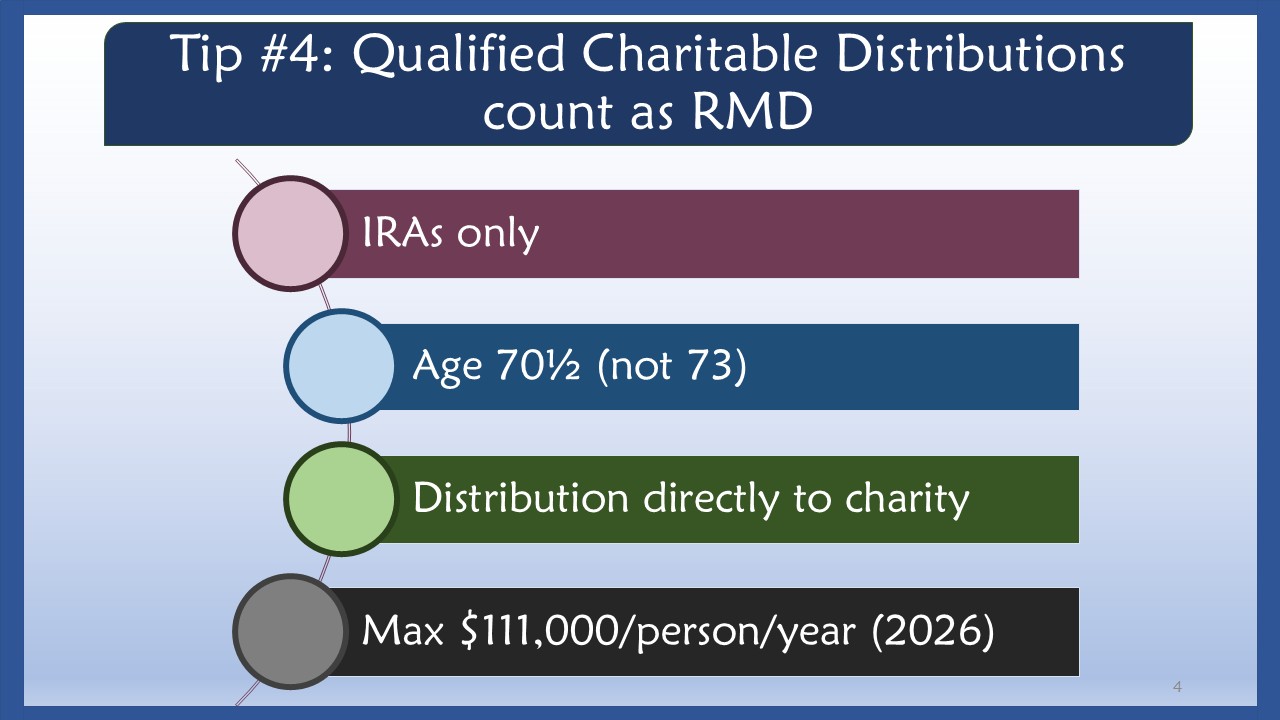
- QCDs have been around for quite a while. When they were first made permanent in 2015, Michael Kitces wrote an extensive explanation. that is still worth reading.
- For now, it’s up to you to remember that you had that distribution sent to a charity and fill out your 1040 accordingly. But beginning in 2025, the 1099-R that includes your QCD may use Code Y to tell the IRS that the distribution is not taxable. As of 2026, the use of that code is still voluntary.
- Code Y isn’t as simple as it might seem, because there are some situations where it might not be a QCD even if the money went straight to a charity.
- You’d already exceeded the annual limit ($110,000 in 2026). In that case, thank you for your generosity!
- You had continued to work past age 70 1/2 (the age at which you can make QCDs) and made deductible contributions to a traditional IRA. In this case, you must take taxable distributions equal to those post-age 70 1/2 contributions before your distributions can be QCDs.
Why take voluntary distributions from retirement accounts & delay Social Security
Before Roth conversions became the big retirement question, financial planners and researchers were already asking whether tapping retirement plans first and using that income to delay claiming Social Security. These first two sources address the question from that perspective: Should I take voluntary distributions from retirement accounts to enable me to delay Social Security and benefit from the substantially larger benefit that would give me?
- Lance Ritchlin, Why 401k And Social Security Coordination Is Critically Important, 401kspecialist.com, http://bit.ly/Why401k (This article is targeted at financial advisers, but you may still find some of the information helpful.)
- James I. Mahaney and Peter C. Carlson, Rethinking Social Security Claiming in a 401(k) World, Pension Research Council Working Paper, The Wharton School, University of Pennsylvania. Available at http://bit.ly/RethinkSocSec. (This paper was written before the recent changes in Social Security claiming strategies and therefore contains some dated information. However, it is still the most thorough discussion on this topic that I am aware of.)
Should I do a Roth conversion?
Now look at the previous question about voluntary distributions and through the lens of a Roth conversion: Rather than taking a distribution and spending it, what it if I convert that distribution into a Roth account? Delaying Social Security is still a factor in figuring out the value of a Roth conversion.
- William Reichenstein, Ph.D., and William Meyer have published extensively on this question. One of their more recent articles, Tax-Efficient Withdrawal Strategies for Five Groups, in the Journal of Financial Planning looks at this how this decision would play out in 5 different situations. While this is written for financial planners, I think you will find it helpful.