
Once you’ve worked hard to save up money in a retirement account like an IRA, 401(k), 403(b), etc., the last thing you want to do is have some of that money going for penalties because you didn’t follow the rules.
- Take it out too early? Penalty.
- Take out too little? Penalty
- Make your charitable contributions by personal check? If you’re at least 70 ½, you missed out on a major tax break.
So let’s review the rules.
Distributions before age 59 ½
You got to defer taxes (or for a Roth account, get tax-free growth) because you essentially entered into an agreement to not touch the money until you were retirement age, which the law determined in this case to be age 59 ½. The tax deferral is the carrot; the 10% penalty tax on early distributions is the stick they use to discourage you from taking money early.
That much is pretty simple. But since the beginning of tax-deferred retirement plans, there have been some exceptions. Qualify for one of the exceptions and you avoid the penalty. The exceptions can be confusing because some apply to only certain types of retirement plans. Where exceptions are concerned, there are two types of retirement plans:
- Qualified plans: employer plans that meet certain IRS requirements. This includes 401(k), profit sharing, Keough, and 403(b) plans.
- IRAs, SEP, and SIMPLE Plans
Sidenote: Did you notice that 457 plans are not listed here? That’s because the 10% early distribution penalty doesn’t apply to them (see the footnote on this IRS list of exceptions).
Here are some of the oldest and therefore most familiar exceptions. Notice which types of plans each one applies to.
- Separation from service: If you left a job during or after the year you reach age 55 (50 for public safety employees) any distributions during that time avoid the penalty (Qualified plans).
- Death: After your death, there will be no early distribution penalties for your heirs regardless of who receives the distributions or their age. (IRAs and Qualified Plans)
- Disability: Total and permanent disability (IRAs and Qualified Plans)
- Taking a series of substantially equal payments: You must calculate annual distributions according to a formula approved by the IRS, and you must take those substantially equal payments each year until you reach age 59 ½, or for at least 5 years, whichever is the longest time period (IRAs and Qualified Plans)
- Payments to an alternate payee under a Qualified Domestic Relations Order (IRAs and Qualified Plans)
- Rollovers: Eligible distributions can be rolled over to another employer plan or IRA within 60 days, or in-plan Roth rollovers. RMDs, for example, are not eligible. (IRAs and Qualified Plans)
Over the years, numerous additional exceptions have been added. There are so many that I’ll be covering those in a future post.
Between age 59 ½ and 73
I call this the Golden Group, because you can do anything you please as far as your retirement accounts go. You can leave all the money untouched, or you can take out as much as you want. You’ll owe tax, of course, on all distributions of tax-deferred money. But it’s entirely up to you: take none this year, just a bit next year, and a bunch the following year for a big home remodel, for example. It’s all fine. There are other considerations, to be sure, before taking out a huge chunk. In addition to simply owing tax on that income:
- The additional income might push some of your income into a higher marginal tax bracket.
- If you’re 63 or older, you might be subject to higher Medicare premiums two years from now, when that additional income could subject you to IRMAA (Income Related Monthly Adjustment Amount). I’ll be writing more about that in October, when we’ll focus on Medicare.
- if you’re receiving Social Security, additional income could make some/more of your Social Security benefits taxable if you haven’t already hit the max.
Age 70 ½
This used to be the age at which you had to start taking Required Minimum Distributions (RMDs). It isn’t anymore. But it is still an important age because the day you reach 70 ½ is the day you become eligible to make Qualified Charitable Distributions (QCDs). And any distribution that qualifies as a QCD is NOT INCOME! How powerful is that? We’ll cover QCDs in detail another day.
Age 73
At this age, the IRS says, “You’re old enough to be retired now. So about that tax deferral…It doesn’t last forever. Ya gotta start taking some of the money out each year.”
You must take an RMD for the year you reach age 73 and for each year thereafter. The custodian of your plan will notify you of the amount. You must take out at least that amount by Dec. 31 each year. You can always take more.
For your very first RMD, you have a grace period that extends the deadline to April 1 of the following year. The RMD for age 74 will be due by the end of that same year, so using the grace period means you’ll end up with 2 taxable distributions within the same year. Whether that’s a good thing or not depends on how it impacts your income taxes. (See the bulleted list of considerations above under 59 ½ to 73.
RMDs only apply to tax-deferred accounts. Roth accounts do not have RMDs for the original account owner. That exception used to apply only to Roth IRAs but it was expanded to all Roth accounts [(401k), 403(b), etc.] in 2024.
How are RMDs calculated?
An RMD is calculated for each retirement account. For example, if you have two 401(k) accounts, you’ll take a distribution from each one. However, if you’re still working for one of those companies, your RMD for that plan won’t start until you retire. If you also have an IRA and a 403(b) from time in a government job, you’ll take separate RMDs from each of those.
There are two situations where you can treat multiple accounts as if they were one and take the RMD however you wish: all from one of the accounts or spread across the accounts in any way you like as long as the total meets the combined RMD amount. You can do this with multiple Traditional IRAs and with multiple 403(b) accounts.
To calculate the RMD yourself, find the account balance from the end of the previous year. For example, if you’re calculating the RMD for 2027, you would look at the value from Dec. 31, 2026. Divide that balance by the factor for your age from the Uniform Lifetime Table in Appendix B, Table III of IRS Publication 590-B. This link will take you directly to the Appendix but you’ll have to scroll down quite a bit further to get to Table III because Table II is really, really long. It may be quicker to use the search box at the top of the screen, type in “Uniform” and hit Tab about 5 times, until you come to the table.
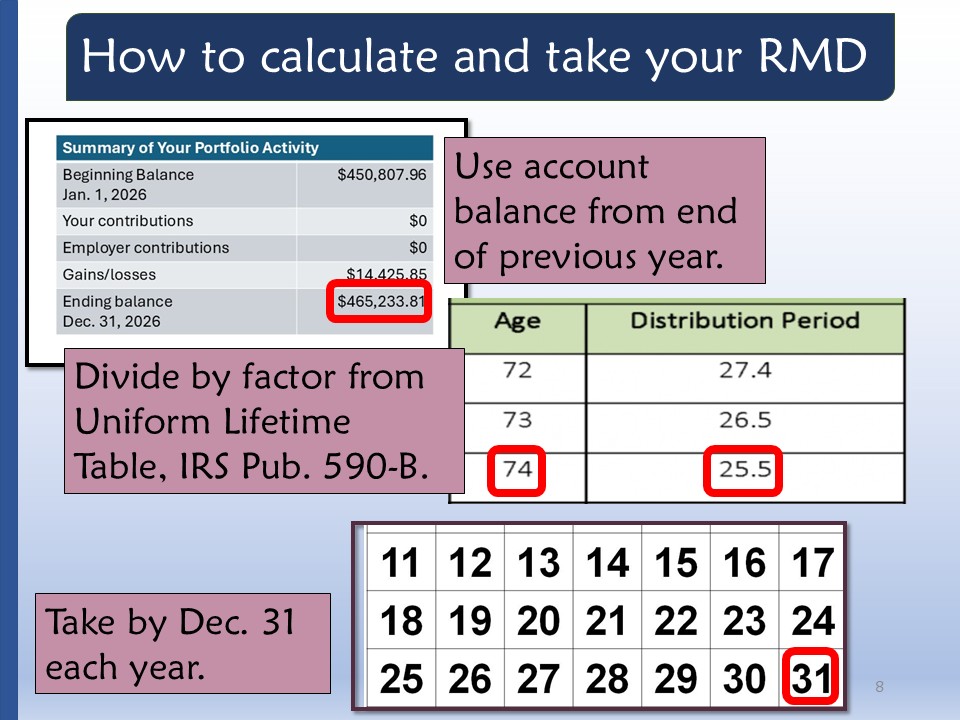
The Uniform Lifetime Table calculates a smaller distribution than if it were based on just your individual age and life expectancy. Instead, it gives you what I call a “theoretical spouse” who is 10 years younger than you. That joint life expectancy is reflected in the factor for each age. For example, at age 73, your factor is 26.5. That is clearly not the life expectancy for a single 73-year old! It is the joint life expectancy of you and that theoretical 63-year old spouse.
If you have a spouse who is more than 10 years younger than you, use Table II, Joint and Last Survivor Life Expectancy.
And if you inherited an account, you will probably use Table 1, Individual Life Expectancy.
I’ll see you here again next week. We’ll dig into those Qualified Charitable Distributions, and examine why they may be a much more beneficial tax break compared to itemizing.
Thanks for leaving a comment. The name you enter will be visible to the public alongside your comment.