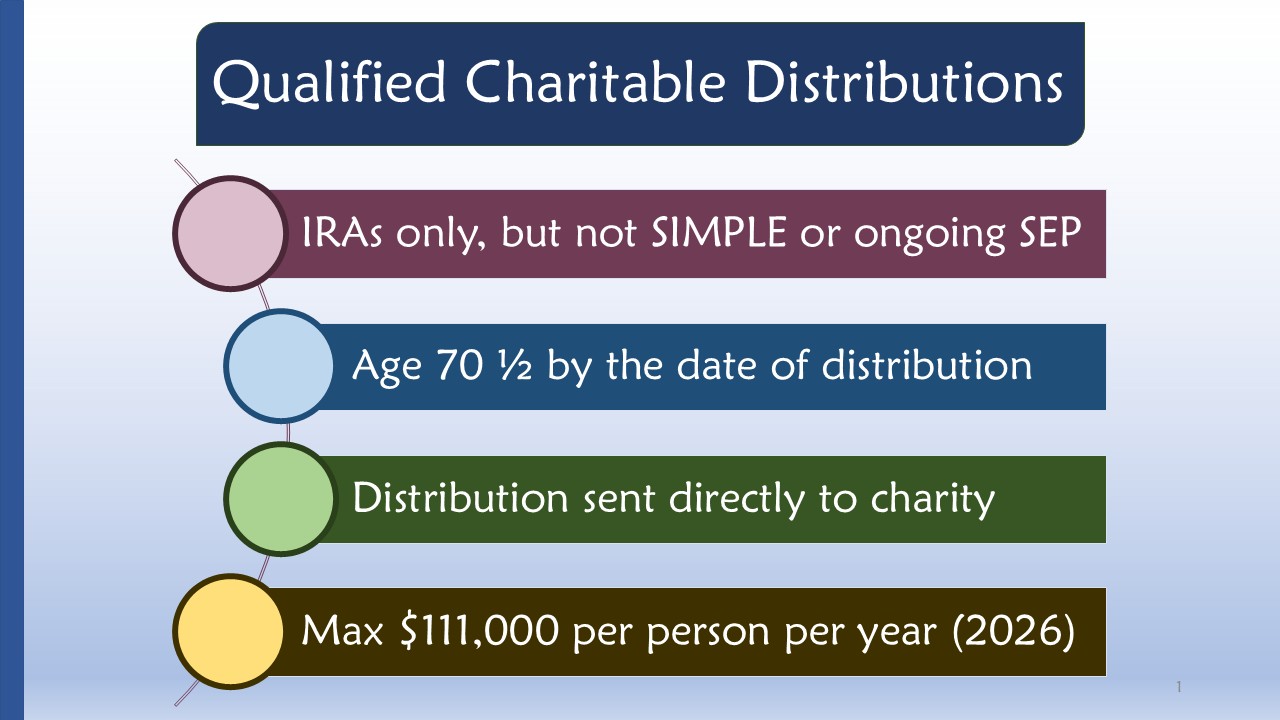
Qualified Charitable Distributions (QCDs) are a powerful tax break. A QCD converts taxable distributions from your IRA into non-taxable income. They even count toward your Required Minimum Distribution. Making a QCD is pretty simple, too.
How does it work?
There are 4 pretty straightforward rules:
- You must have reached age 70 ½ by the day you make the distribution.
- A QCD can only be made from an IRA
- The money must go directly from the plan custodian to a qualified charity.
- The limit for QCDs in 2026 is $111,000 per eligible person. That number is adjusted each year to keep pace with inflation.
Let’s dig into a little more detail on those rules.
- You must have reached age 70 ½ by the day you make the distribution. 70 ½ is not a typo. When the RMD age was pushed from 70 ½ up to age 73, they left 70 ½ as the beginning age for QCDs. While discussions around QCDs often focus on the fact that taking a QCD counts toward your RMD, you’ll be eligible to make a QCD for two or even three years before you have RMDs, depending on the month of your birthday.
- A QCD can only be made from an IRA – not from a 401(k), a 403(b), or a 457 plan. If you inherit a Traditional IRA, you can make a QCD from that account as long as you have reached age 70 ½.
- To make a QCD from a SEP or SIMPLE IRA, there’s an additional requirement: the account cannot be “ongoing.” An ongoing account is one where your employer is still making contributions to your account: “…an employer contribution is made for the plan year ending with or within your tax year in which the distribution would be made.” See IRS Pub 590-B.
- The money must go directly from the plan custodian to a qualified charity. There are at least three ways to do that: 1) You can direct the custodian of the account to send the contribution directly from your account to the charity. 2) The account custodian can send you the check as long as it’s made out to the charity, and you can then have the pleasure of delivering it yourself. 3) If the custodian has given you a checkbook to take distributions from the account, you can write the check out to the charity. Here’s what you cannot do: You cannot take the distribution, deposit it into your personal checking account, and then write a check to the charitable organization. That is not a QCD. To be certain the organization you want to support is qualified to receive a QCD, check the IRS database of tax exempt organizations and tips for using it.
- The annual limit for 2026 is $111,000 per eligible person. That number is adjusted each year to keep pace with inflation. For a married couple who have both reached the age of 70 ½, they can each make a QCD from their individual IRAs of up to $111,000. You can make a QCD that is larger than your Required Minimum Distribution. Let’s say that your RMD is $50,000. You can still make a QCD for up to $111,000 for 2026. The extra amount is a voluntary distribution, not an RMD, but it still qualifies as a QCD.
What makes a QCD so valuable?
In many situations, a QCD offers a bigger tax benefit than other ways of reporting charitable contributions on your tax return. That’s because of several features of a QCD.
A QCD reduces your Adjusted Gross Income (AGI). In addition to reducing your income tax, a lower AGI can also help you in other ways.
- The new enhanced Senior Tax Deduction (2025-2028) begins to phase out at modified adjusted incomes of $75,000 for single filers and $150,000 for joint filers. If your income is over those limits, a QCD could reduce your income enough for you to receive the deduction.
- As much as 85% of your Social Security benefits could be taxable, depending on your income. A QCD might reduce your income enough so that you pay tax on less of your Social Security benefits.
- In addition to the standard monthly premium that you pay for Medicare Parts B and D, you may also have to pay the Income Related Monthly Adjustment Amount (IRMAA) if your modified adjusted gross income is above $109,000 for single filers or $218,000 for married filing jointly. IRMAA has five income tiers with Part B surcharges of $81.20 per month up to $485 per month for 2026. Your QCD could help you avoid IRMAA or move you to a lower tier. IRMAA is based on your tax return from two years prior. For 2026, IRMAA is based on your 2024 tax return.
- There are other benefits including the Lifetime Learning credit and property tax relief from your local government for which eligibility is determined by your AGI.
Every dollar of your QCD counts. Your entire QCD is subtracted from AGI, up to the maximum $111,000 (2026) per person per year. That usually makes a QCD more advantageous than an itemized deduction, where your deduction is less than the actual amount of your donation. (See more about Itemized Deductions, below.)
There is no minimum income that you must have in order to make a QCD. Neither will a high income make you ineligible; there is no income limit or phase-out.
There is no minimum amount that you can claim as a QCD. However, your retirement account custodian may require that any distribution be at least a certain dollar amount, such as $250.
How does the tax benefit of a QCD compare with other tax breaks for charitable contributions?
As of 2026, there are three main ways that you can get a tax break for charitable contributions.
Beginning in 2026, if you take the standard deduction, single filers claim cash donations of no more than $1000, and married filing jointly can claim up to $2000 per year under the new charitable deduction for non-itemizers. There are some limitations on the charities to which you make the contribution; They cannot be a donor-advised fund or certain private foundations.
Itemized deductions are one way to possibly get a tax benefit. But there are several limitations that result in your deduction being less than the amount of your donation. With today’s large standard deductions, only about 10% of people itemize. If you can’t itemize, you get no tax benefit at all from your contribution, beyond the new charitable deduction for non-itemizers discussed in the previous bullet. Even if you itemize, you will only benefit to the extent that your total itemized deductions exceed the standard deduction.
In the example below, the taxpayer wants to make a charitable donation of $15,000 for 2026. If they do it via a QCD, they can also claim the Standard Deduction of $32,200 for married filing jointly. The QCD plus the Standard Deduction together reduces their taxable income by $47,200.
If they claim a charitable contribution as an itemized deduction, they will not be able to itemize the entire $15,000 Beginning in 2026, you can only deduct the amount of your charitable contributions that exceed 0.5% of your adjusted gross income (AGI). If their AGI is $100,000, the first $500 of the donations is not deductible. The deductible amount is only $14,500 resulting in total itemized deductions of $33,500.
Using a QCD reduces their taxable income by $13,700 more than the itemized deduction.

Deductions reduce taxable income. But they do not reduce Adjusted Gross income. As a result, itemized deductions will not help you with regard to the new enhanced Senior Tax Deduction, your Social Security benefits being taxable, or any of the other AGI-based benefits listed under the first bullet of What makes a QCD so valuable?
Donating an appreciated asset that you have owned for more than one year is a special case where the tax benefit goes beyond the value of the itemized deduction. As a result, donating an appreciated asset may give you a better tax result than doing a QCD. Not only can you deduct the market value of the asset as an itemized deduction (with the limitations mentioned previously), you also avoid reporting and paying tax on the appreciated value. The greater the appreciation is relative to the asset’s value, the greater this benefit may be. Talk to your financial advisor for advice about which approach will be best for your situation. You could also try out different scenarios using your tax preparation software or Quicken to compare the tax impact of QCD or donating the appreciated asset.
Caution: Read this before making Traditional IRA contributions in the year you reach age 70 ½ or later
There’s one situation that could really trip you up where QCDs are concerned. It all started when the age limit for making contributions to Traditional IRAs was removed in 2020.
But contributions in the year you turn 70 ½ or later may not be a good idea if you plan to make QCDs due to the QCD Anti-Abuse Provisions. If you make such contributions, you will have to try to make QCDs totaling the amount of those age 70 ½ and later contributions, only to have them denied by the IRS. Once the dollar amount of those denied QCDs equals the amount of those problematic contributions, further QCDs will be allowed. As a consolation prize, you would be able to use those failed QCDs as itemized deductions. See Michael Kitces’ Nerds Eye Blog from 2020 for a full explanation and possible work-arounds. The simple solution is to avoid making Traditional IRA contributions in the year you reach age 70 ½ or later.
I’ll see you here again next week. We’ll continue with the theme of Getting the Most from Your Retirement Savings. The focus will be the advantages and the potential problems with moving or combining retirement accounts via rollovers and transfers.
Thanks for leaving a comment. The name you enter will be visible to the public alongside your comment.