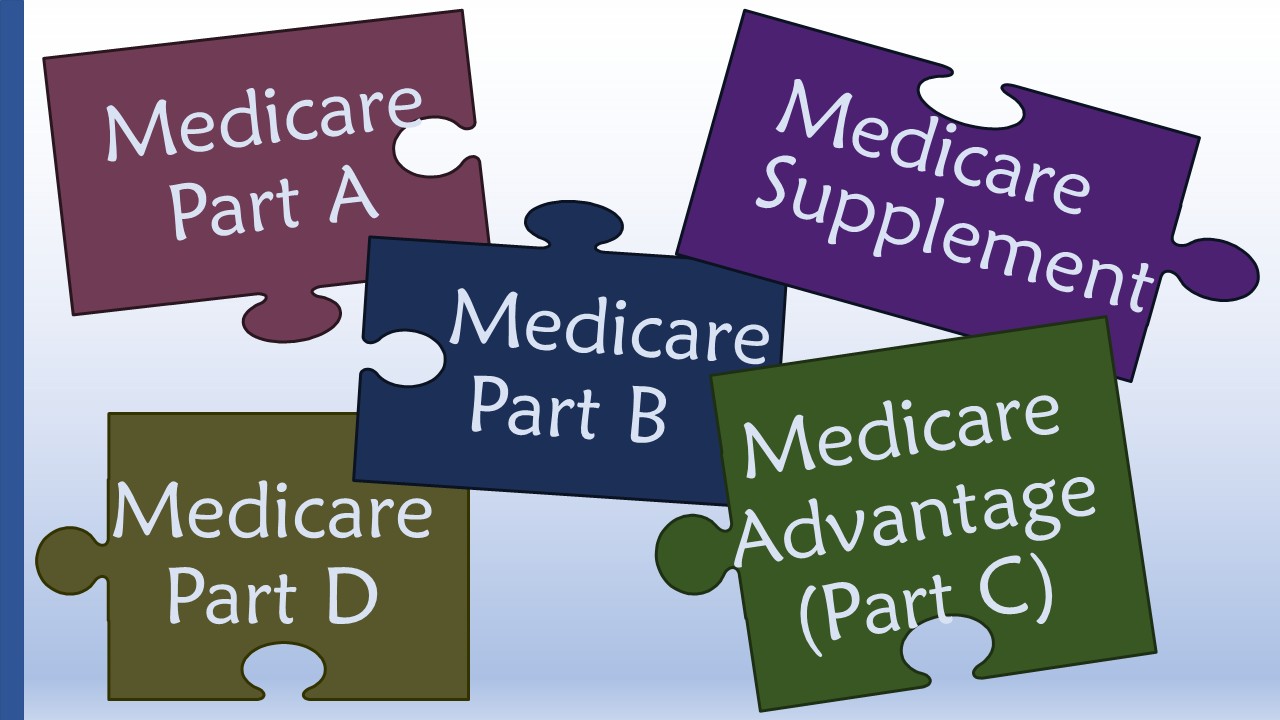
Call it alphabet soup. Call it puzzle pieces. However you describe Medicare, you need to know what each of the pieces do and how they work together – and how one replaces all the others in the case of Medicare Advantage.
When you become eligible for Medicare, your big decision is whether to go the Original Medicare route or the Medicare Advantage route. Making a good decision means you need to understand how both paths work. That is the goal of this post. In the next one, I’ll walk you through how to compare Original Medicare with Advantage and give you some tips for choosing between them.
Original Medicare

“Original Medicare” sounds like it’s just one thing. In reality, it’s made up of 4 distinct parts.
Medicare Part A is often referred to as hospital coverage. It is the part of Medicare that pays when you are admitted to a facility: a hospital, a rehab facility or a skilled nursing home. It also covers hospice care.
Medicare Part B covers the rest of your healthcare: doctor and specialist visits, lab work and other tests, therapy, durable medical equipment, outpatient care, and home health care.
Medicare A and B claims and payments are handled by Medicare – part of the federal government. They will cover pretty much any medical care that your doctor says you need. But they don’t pay all of the cost. You will have deductibles, copays and co-insurance. And unlike employer insurance that you may have had in the past, there is no limit on your out-of-pocket expenses. That can leave a big gap, It also doesn’t cover prescriptions. That’s why most people will add two other types of insurance to fill those gaps: Medicare Supplement and Medicare Part D – Prescription coverage.
Medicare Supplement, also known as Medigap coverage, is a policy that you buy from a commercial insurance company to cover the out-of-pocket expenses that are your responsibility after Medicare A and B pay their part.
Medicare Supplement policies are available in several different plans denoted by letters of the alphabet: A, B, D, G, K, L, M, or N. It can get confusing since we also have Medicare Parts using letters of the alphabet: A, B, C, and D.
Medicare Supplement plans are standardized by federal law. The plan letter tells you which out-of-pocket expenses that plan covers. Any Plan G, for example, must cover exactly the same costs as every other Plan G, regardless of which company you purchase it from. All plan Ns must cover the same expenses, etc.
There are nine types of expenses that may be covered by these plans; which ones are covered by each plan is laid out in the image, below. A checkmark means that the plan pays your out-of-pocket costs for that type of expense after Medicare A or B paid their part for covered care. A percent sign (%) means that the plan covers that portion of that expense type. Note: Plans C and F have hashmarks over them to indicate that they are no longer sold except to individuals who were already eligible to enroll in Medicare as of January 1, 2020. Those who already have a Plan C or F can keep them.

Unlike the other parts of Medicare, you only have one Open Enrollment Period for Medicare Supplement insurance. That is the time when you have Guaranteed Issue Rights, meaning that you can purchase any policy from any company; you cannot be turned down or charged more because of health issues. Last week’s post has much more detail about Medicare enrollment periods.
If you have employer, union, Medicaid, or retiree insurance that will pay secondary to Medicare, that will serve the same function as a Supplement plan and you do not need to purchase one.
Medicare Part D insurance helps pay the cost of your prescriptions. You buy this policy from a commercial insurance company. While there are criteria that each Part D plan must meet, each insurance company and each plan is different. They each have their own network of providers, their own formulary (the list of drugs that they cover), and their own payment structure of premiums, deductibles, and copays or co-insurance. It is imperative that you compare plans carefully each year to find the one that matches your needs best. Pay particular attention to whether each of the prescriptions that you take is included in their formulary.
If you have creditable prescription insurance (one that meets the same criteria as a Part D Plan) from your employer, previous employer, union, etc., you do not need to purchase Part D insurance. When or if you lose your prescription insurance, you will need to show that you had creditable coverage and are entitled to a Special Enrollment Period to sign up for a Part D plan without any late enrollment penalty. You must enroll in a Part D plan within 63 days of losing your coverage.
The Alternative: Medicare Advantage

Medicare Advantage is the alternative to Original Medicare. You may also hear it called Medicare Part C, or abbreviated as MA (Medicare Advantage), MAP (Medicare Advantage Plan) or MAPD (Medicare Advantage Plan with Part D). As depicted in the image above, a Medicare Advantage replaces Medicare Parts A, B, D (in most cases), and a Supplement Plan. It bundles all that coverage into one policy. They are Medicare-approved commercial insurance plans.
To qualify to be sold as an Advantage plan, the policy “must cover emergency/urgent care and almost all medically necessary services Original Medicare covers.” (Medicare.gov) They can also offer extras that Original Medicare does not provide, such as some coverage for vision, dental, or hearing needs, fitness memberships, and other health-related expenses.
Most Medicare Advantage plans are HMO plans, but a few are PPO. If your employer insurance was an HMO, you probably already know how they work. In order for your healthcare to be covered by the plan, the provider must be in the plan’s network, which is often in a specific geographic area. Out-of-network care is usually only covered in an emergency. You may be required to have a referral from your primary care physician to get other services, and some services will require pre-authorization.
Before you enroll in an Advantage Plan, you must first sign up for Medicare Parts A and B. (See last week’s post for more about enrollment periods.). You will continue to pay your Medicare Part B premium (and Part A if you are one of the few people who pay for it). That premium helps pay for your Advantage Plan. If you are subject to IRMAA (higher Medicare premiums based on your income), you will also still have to pay those amounts when you are covered by an Advantage plan.
Networks can change, so it is important to check each year that your primary physician and other care providers will still be in-network. You can switch to another Medicare Advantage Plan during the annual fall Open Enrollment or in the January 1 to March 31 Medicare Advantage Open Enrollment period.
You can also leave an Advantage plan and return to Original Medicare during those times. You would need to sign up for Part D. With a few exceptions, you would have to undergo medical underwriting to get a Medigap policy.
Up Next: How to Choose
In the next post, I’ll compare Original Medicare and Advantage on
- Doctor and hospital access
- Constraints on receiving care
- Monthly premiums and out-of-pocket costs
And that’s still not the end of your decisions! If you choose Original Medicare, you’ll probably need to choose both a Prescription Part D plan and a Medigap policy. On the Advantage path, you’ll have to choose the exact policy that fits you best. I’ll show you how to use the Plan-Compare tool on Medicare.gov to help with that step.
Thanks for leaving a comment. The name you enter will be visible to the public alongside your comment.