You’ve heard the words: Rollover, transfer, convert. But you may not know the rules and risks about moving retirement funds from one account to another. That’s the purpose of today’s post.
There are numerous situations where you might want to move or combine accounts. Maybe you have money in an old employer plan. Maybe you’ve reached the age for Required Minimum Distributions and you don’t want to deal with taking individual RMDs from multiple accounts. Perhaps you’re considering making Qualified Charitable Distributions which must be made from an IRA, but most of your retirement money is in an employer plan. Or you’re not quite sure what a Conversion is.
Ways of Moving Money Between Accounts
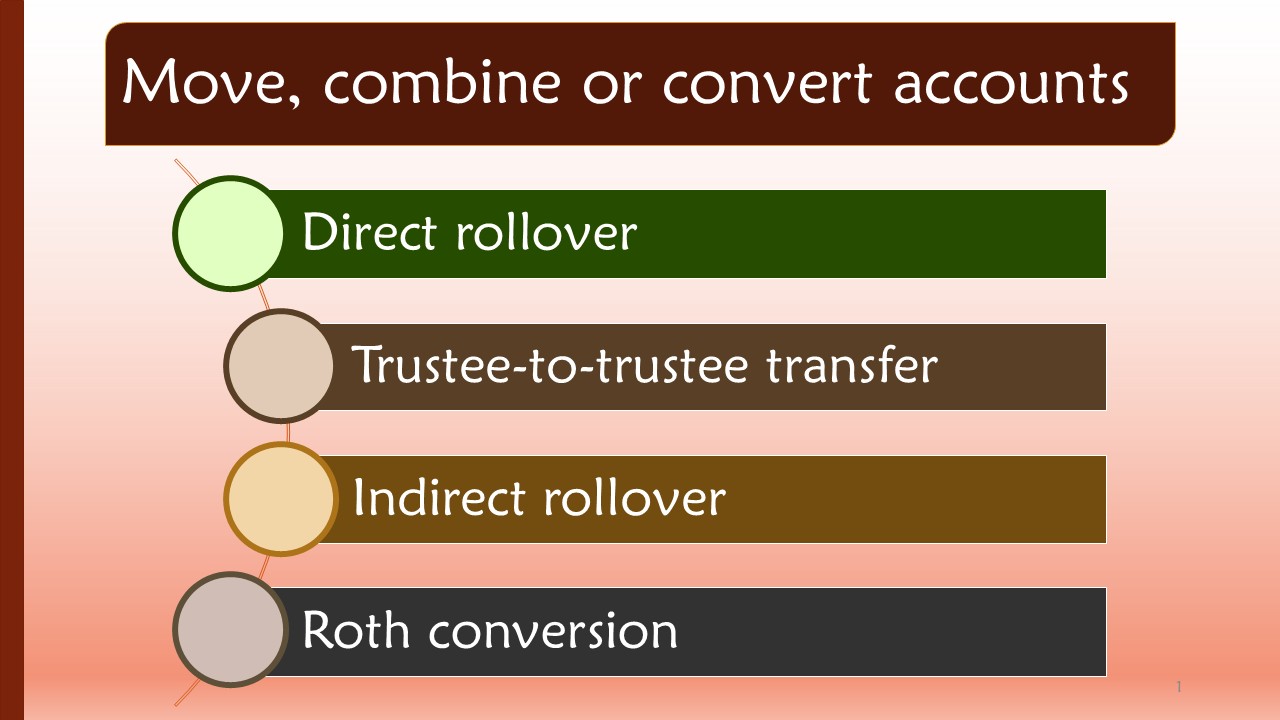
Most people use the word rollover for moving money from any retirement account to another. But technically, there are specific terms for different types of transfers.
- Direct Rollover refers to moving money directly from an employer plan to an IRA.
- A Trustee-to-Trustee Transfer is when you move money between IRAs, either from one traditional IRA to another traditional IRA, or from one Roth IRA to another Roth IRA.
- Indirect Rollovers occur when you take a distribution from retirement account #1, deposit it into a non-retirement account such as a checking account, and then move funds into Retirement Account #2 – or even back into Retirement Account #1. Spoiler alert: indirect rollovers are usually not the best method to use.
- Conversion means that you are transferring money from a tax-deferred retirement account to a Roth account. Since the money in the tax-deferred account has never been taxed, moving it to a Roth account is a taxable transaction.
Direct Rollovers and Trustee-to-Trustee Transfers
Direct Rollovers and Trustee-to-Trustee Transfers have one important thing in common: the money moves directly from one custodian to the other. You never have possession or control of the money. It is clean and simple, especially when compared to Indirect Rollovers.
If you are 73 or older, you must take your annual Required Minimum Distributions from your employer plan before you can move additional money to an IRA with a Direct Rollover. You’ll get a 1099R showing the amount that you transferred. Code G in box 7a indicates that this was a direct rollover and the taxable amount will be $0.
Trustee-to-Trustee Transfers between IRAs do not generate a 1099R, and there is no requirement that you take any RMD first. That is because of the special treatment of IRAs by the IRS. They generally lump all of your IRAs together for tax purposes. Look at example where you have 3 different traditional IRAs. You add up the RMDs for all of them and take the RMDs in any way that you want: all from one account, an equal amount from each one, or different amounts from just two of the accounts. Anything goes as long as you take at least the required amount; it’s all the same to the IRS. Similarly, when you transfer funds from one IRA to the other, it’s not reportable to the IRS and there’s no 1099R.
Even though you requested a Direct Rollover or a Trustee-to-Trustee transfer, you might receive a check from the original custodian. The check should be made out to the new custodian as trustee for the benefit of the account owner. For example: First Bank of New City, trustee, FBO of Judith Stone. You simply deposit the check into your IRA at First Bank of New City.
I have some personal experience with this. Years ago, I set up a new IRA account and instructed the custodian of my former employer’s 401(k) to transfer all of the funds to the IRA. I received what I thought was a copy of the check, showing the IRA as the trustee and me as the beneficiary. I filed it away and gave it no more thought, until a month passed and there was still no money in the IRA. I pulled the “copy” of the check out in preparation for calling and complaining to the 401(k) custodian. Much to my surprise, it was a real check! It was on such flimsy paper that I hadn’t realized it until I took a closer look. It had been nearly 60 days since the check had been issued. Since it was a Direct Rollover, the 60-day limit did not apply. But it was still pretty nerve-wracking. It all ended well, except that I missed out on two full months of investment returns.
60-day Rollovers Come with Complications

An Indirect Rollover may not achieve the result you intended. Here’s why.
- It starts with the distribution itself. Say you have $10,000 in Plan A. You request a full distribution to be sent to you as a personal check or maybe electronically deposited into your checking or savings account. You’re expecting $10,000, but what you get is $8,000. What happened? By law, Plan A was required to withhold 20% of the distribution for income taxes. It doesn’t matter that you plan to roll it over into Plan B. The fact that it was going directly to you, not straight to another retirement plan means withholding is required. If you were doing an indirect rollover from an IRA, the default withholding rate is 10%, but you can request any amount that you choose.
- You have 60 days to complete the rollover by moving the money into Plan B. If you miss the 60-day deadline, the entire amount ($10,000 in our example) will be treated as a taxable distribution. You can request a waiver of the 60-day limit in certain situations. There’s even an automatic waiver if Plan B received the funds within the 60 days but they failed to deposit the money correctly. If you do not have a waiver and you are younger than age 59 ½, you may also owe a 10% early distribution penalty unless you qualify for an exception. For a complete list of exceptions for both IRAs and Qualified Plans, see the IRS Retirement Topic article.
- You know about the 60-day rule, so you get the money moved in time. But here’s another complication. If you only deposit the $8000, the $2000 withheld for taxes becomes a taxable distribution. And once again, if you are younger than age 59 ½, you may also owe a 10% early distribution penalty unless you qualify for an exception. You’ll need to find $2000 from somewhere else to make up the difference, so that you can deposit the full $10,000 and avoid all these taxes and possible penalties.
- For IRAs and Roth IRAs only, there is a limit of one indirect rollover per 365 days. Even if two Indirect Rollovers are in two different calendar years, they must still be at least 365 days apart. Otherwise, the rollover will be disallowed and…you guessed it…say it with me… the entire amount ($10,000 in our example) will be treated as a taxable distribution. If you are younger than age 59 ½, you will also owe a 10% early distribution penalty unless you qualify for an exception.
Conversions
The costs and benefits of a Roth conversion must be carefully evaluated, since the cost can be significant. Those costs come not only in the form of income taxes on the converted amount itself but also the knock-on effects including higher Medicare premiums two years later due to the Income Related Monthly Adjustment Amount (IRMAA), tax on Social Security benefits, the phase-out of the new enhanced Senior Tax Deduction (effective in tax years 2025-2028), and possibly loss of other benefits you receive that are based on income. For more detail about those issues, see my two previous blog posts: Basics of Roth Conversions and Converting to a Roth IRA: Factors to Consider.
You do not need to convert all of the money in an account at once – and you probably shouldn’t. Determining the amount to convert on a year-to-year basis allows you to estimate and manage conversion costs and tradeoffs by choosing the optimal conversion amount for that year’s circumstances. The loss or reduction of the new enhanced Senior Tax Deduction could be enough to change the outcome for someone who determined conversions were worth it in prior years.
If you have non-deductible contributions in the “source” account, those amounts will not be taxed when you convert. But you cannot convert just those amounts. If 10% of the money in Plan A is from non-deductible contributions, then 10% of whatever amount you convert will be deemed to come from the non-deductible amounts and will not be taxed.
In the past, one of the main reasons so many people converted to Roth IRAs instead of doing an in-plan conversions (moving money from the tax-deferred side of the employer plan to the Deemed Roth side) was that Roth IRAs had no RMDs. As of 2024, that reason disappeared because no Roth accounts have RMDs. If your employer plan offers a Roth option, doing an in-plan conversion could be the best choice.
Another thing that changed a number of years ago is that you can complete the conversion to a Roth IRA in just one step, directly from the employer plan to a Roth IRA. Previously, you had to go through two steps: tax-deferred employer plan to Traditional IRA, and from Traditional IRA to Roth IRA.
Cautions & Considerations before Moving Money
The IRS has a very helpful chart that maps out which types of retirement accounts you can roll over to which types of accounts. Footnotes explain any limits or requirements. For example, you can identify which rollovers are Roth conversions; they each have footnote number 3, “Must include in income.” Click the image or here to open the full-size chart on IRS.gov.

Even though IRS rules allow rollovers between most types of retirement accounts, individual plans are not required to accept rollovers. The IRS guidance is, “Check with your new plan administrator to find out if they are allowed and, if so, what type of contributions are accepted.” (IRS, Rollovers of retirement plan and IRA distributions)
When moving money from an employer plan to an IRA, consider whether it is wise to commingle those employer-plan funds with other IRA money in a single Traditional IRA. If you wanted to transfer that money into another employer plan in the future, some employer plans would not accept commingled money even though IRS rules allow it.
Another consideration before moving money from an employer plan to an IRA is whether you might be giving up any of these things:
- Future penalty-free distributions: If you are moving money from a job you left after age 55 but you are not yet at least 59 ½, be aware that you may pay the 10% early distribution penalty if you take distributions from that IRA before reaching 59 ½. There would be no penalty if the money were still in the 401(k) when you took the distribution because of the “separation after age 55” exception for employer plans.
- Protection from creditors: Federal law protects retirement accounts from creditors. Protection for IRAs depends on state law, which can vary widely. Protection under Illinois law appears to be strong. (Cutler & Associate or Robbins DiMonte attorneys for a more detailed explanation.)
- Access to low-cost investments: All mutual funds have annual expenses that are measured by a standardized calculation called the expense ratio. But they also have different share classes with different fee structures. In your employer plan, you may have access to institutional shares (I or Y shares), which may have significantly lower expense ratios. Other retirement plans may offer retirement shares (R-shares) which, according to Morningstar, can have widely varying expense ratios. These share classes will also avoid other fees that you might pay on your own, such as front-end loads (A-shares) or back-end loads (B-shares).
Transferring money from one retirement account to another can be a wise move. The challenge is to know the rules and avoid complications.
This post wraps up the September series about Getting the Most from Your Retirement Savings. For October, we’ll move on to Medicare. I’ll start by trying to make sense of Medicare’s various enrollment periods, including the annual open enrollment period that begins Oct. 15.
Thanks for leaving a comment. The name you enter will be visible to the public alongside your comment.